Push pull legs routine: the complete PPL workout plan
 Anton YefanovUpdated
11 min read
A push pull legs split (PPL) trains your body in three workouts: push for chest, shoulders and triceps, pull for back and biceps, and legs for everything below the waist. Run it three days a week and each muscle gets one hard session. Run it six days and each muscle gets two. Below is the full routine with sets, reps and rest, the schedule for both versions, and how to add weight week after week.
- Days per week
- 3 or 6
- Session length
- 60 to 75 min
- Level
- Beginner to advanced
- Equipment
- Full gym
Key takeaways
- Push trains chest, shoulders and triceps. Pull trains back, rear shoulders and biceps. Legs trains quads, hamstrings, glutes and calves.
- Six days a week hits every muscle twice, which is the frequency the research favors for growth. Three days a week hits each muscle once and is the better start for beginners.
- Open each workout with a heavy compound lift for 6 to 8 reps, then move to 8 to 15 reps for the accessories. Rest 2 to 3 minutes on the big lifts.
- Progress with double progression: when you hit the top of the rep range on every set, add the smallest weight jump and build back up.
- Twice a week mostly helps because it lets you do more total sets without marathon sessions. When weekly volume is matched, studies find frequency barely matters.
What is a push pull legs split?
A push pull legs split groups exercises by the movement they share. Every pressing movement goes on one day, every pulling movement on another, and the lower body gets a day of its own. Muscles that work together are trained together, so the triceps that help on the bench press are finished off on the same day instead of being tired again tomorrow.
That grouping is the whole appeal. Each day has a clear job, the muscles you trained get at least 48 hours before they are hit again, and the routine scales from three days to six without changing a single exercise.
| Day | Main muscles | Movement | Typical lifts |
|---|---|---|---|
| Push | Chest, front and side shoulders, triceps | Pressing away from the body | Bench press, overhead press, dips |
| Pull | Lats, upper back, rear shoulders, biceps | Pulling toward the body | Rows, pulldowns, pull-ups, curls |
| Legs | Quads, hamstrings, glutes, calves | Squatting and hip hinging | Squat, Romanian deadlift, leg press |
The push pull legs routine
Here is the full program. Switch between the three workouts with the tabs, flip between the 3 day and 6 day week, and hover or tap any exercise to watch it. The figure beside the list shows every muscle that session works.
Weekly schedule
Push · Chest, shoulders, triceps
Hover or tap an exercise to see it
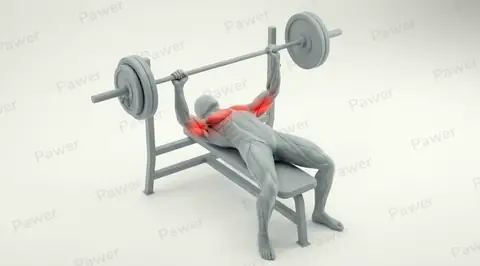 Barbell Bench Press
Chest
3 × 6-8
Rest 2-3 min
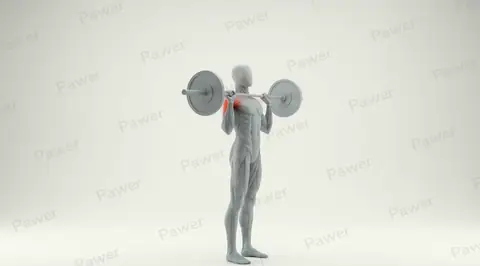 Barbell Overhead Press
Shoulders
3 × 8-10
Rest 2 min
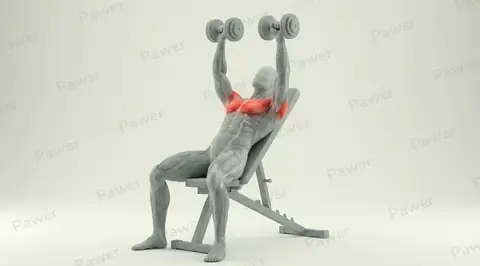
3 × 8-12
Rest 2 min
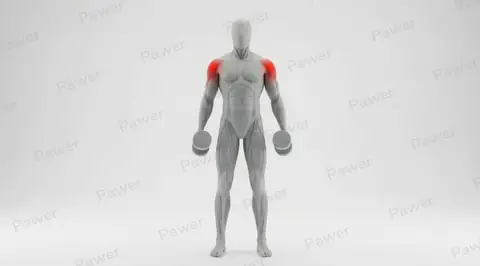 Dumbbell Lateral Raise
Shoulders
3 × 12-15
Rest 1 min
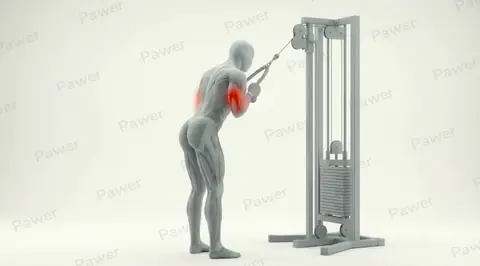 Cable Rope Pushdown
Triceps
3 × 10-12
Rest 1 min
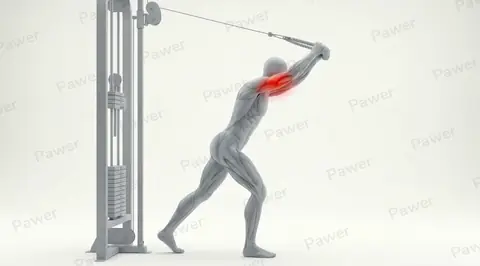
2 × 10-12
Rest 1 min
Rep ranges are per set. Stop each set with one to three good reps left, except the last set of an isolation exercise, which can go closer to failure.
Every workout follows the same order: one heavy compound lift while you are fresh, a second compound or a lighter variation, then isolation work for the smaller muscles. Do the exercises in the order listed. Moving the bench press to the end of push day would cost you more weight on it than any accessory gains back.
3 day vs 6 day push pull legs
The exercises do not change between versions. What changes is how often each workout comes around, and with it how many hard sets each muscle gets per week.
| 3 days a week | 6 days a week | |
|---|---|---|
| Each muscle trained | Once a week | Twice a week |
| Chest (direct sets) | 6 | 12 |
| Back (direct sets) | 9 | 18 |
| Quads (direct sets) | 8 | 16 |
| Hamstrings (direct sets) | 6 | 12 |
| Side shoulders, biceps, triceps | 3 to 5 each | 6 to 10 each |
| Best for | Beginners, busy weeks, older lifters | Intermediates chasing size |
The research leans toward training each muscle at least twice a week. A meta-analysis of ten studies found higher frequencies produced larger gains in muscle size than once a week (effect size 0.49 vs 0.30), and its authors recommend training major muscles at least twice a week (Schoenfeld et al., 2016).
The twist came three years later. A larger review of 25 studies found that when total weekly volume is the same, frequency makes no meaningful difference to growth (Schoenfeld et al., 2019). So the 6 day version is not magic. It wins because it doubles your weekly sets, and more sets tend to mean more growth: each extra weekly set was linked to a small, steady increase in muscle gained (Schoenfeld et al., 2017).
Sets, reps and rest times
How heavy should each set be?
Pick a weight you can lift for the bottom of the rep range with clean form. Each set should end with one to three reps left in the tank. That is RPE 7 to 9, the effort scale explained in our guide to RPE. If you cannot judge it yet, film a set: when the bar or dumbbells slow down sharply, you are about two reps from failure.
Working sets come after warm-ups. Do two or three lighter ramp-up sets before the first exercise of each day, and use the warm-up calculator to get the exact weights. Warm-up sets do not count toward the numbers in the plan.
How long to rest between sets
Rest longer than feels necessary on the big lifts. In a study of trained men doing 3 sets of 8 to 12 reps, resting 3 minutes between sets produced more strength on the squat and bench press and more thigh growth than resting 1 minute (Schoenfeld et al., 2016). Short rest makes you lift less on the next set, and lifting less is the opposite of the point.
| Exercise type | Examples | Rest |
|---|---|---|
| Heavy compound | Squat, bench press, barbell row | 2 to 3 min |
| Secondary compound | Incline press, pulldown, leg press | About 2 min |
| Isolation | Lateral raise, curl, pushdown, calf raise | 60 to 90 s |
How to progress on push pull legs
A routine only works if the numbers go up. The simplest way to make that happen is double progression: keep the weight the same and add reps until you hit the top of the range on every set, then add weight and start again at the bottom.
| Week | Weight | Reps per set | What to do next |
|---|---|---|---|
| 1 | 60 kg (135 lb) | 8, 7, 6 | Same weight, beat the reps |
| 2 | 60 kg (135 lb) | 8, 8, 7 | Same weight, beat the reps |
| 3 | 60 kg (135 lb) | 8, 8, 8 | Top of the range on every set: add weight |
| 4 | 62.5 kg (140 lb) | 7, 6, 6 | Build back up to 8, 8, 8 |
Write every set down. Double progression needs last week's numbers in front of you, and memory is not reliable after six workouts. A training log app that shows your previous sets beside the current ones makes this automatic.
PPL for beginners, and without a full gym
Push pull legs works for beginners, but run the 3 day version and keep the first two exercises of each day the focus. If six exercises feel like too much, drop the last one from each workout for the first month. New lifters progress quickly on very little volume, so there is no reason to start with the maximum.
With only dumbbells and a bench, the structure stays the same and the exercises change. Every swap below trains the same muscles through the same movement.
| Gym exercise | Dumbbell swap |
|---|---|
| Barbell bench press | Dumbbell bench press |
| Barbell overhead press | Seated dumbbell overhead press |
| Barbell row, cable row | One-arm dumbbell row |
| Lat pulldown | Pull-ups on a doorway bar |
| Barbell squat, leg press | Goblet squat and Bulgarian split squat |
Push pull legs vs other splits
PPL is one of four common ways to organize a week. None is best for everyone. The right one is the one that fits the days you can actually train.
| Split | Days a week | Each muscle per week | Best for |
|---|---|---|---|
| Full body | 2 to 3 | 2 to 3 times | Beginners, minimal time |
| Upper / lower | 4 | Twice | A balanced 4 day week |
| Push pull legs | 3 or 6 | Once or twice | Flexible schedules, building size |
| Bro split (one muscle a day) | 5 | Once | Lifters who like long single-muscle sessions |
Because weekly volume matters more than how it is divided, any of these works when the total sets are similar (Schoenfeld et al., 2019). PPL's advantage is that it handles both a 3 day and a 6 day week with the same three workouts, so a busy month does not mean starting a new program.
Common push pull legs mistakes
- Starting on 6 days. Six sessions with no lifting background is a fast route to sore joints and skipped workouts. Earn the sixth day.
- Skipping leg day. It is the hardest of the three and the easiest to miss. If a session has to go, move it, do not drop it.
- Adding more exercises. Twelve chest exercises on push day is not a better program. Add a set to what is there before adding a new movement.
- Training to failure on every set. Ending compound sets with a rep or two in reserve keeps form clean and lets you recover for the next session.
- Not tracking the weights. Without last week's numbers, double progression is guesswork.
Frequently asked questions
Is push pull legs good for building muscle?
Yes. Run six days a week, it trains every muscle twice with 12 to 18 direct sets per major muscle, which sits in the range the research associates with good growth. The 3 day version builds muscle too, just more slowly for trained lifters.
Is push pull legs good for beginners?
Yes, as a 3 day routine. Beginners grow on less volume, and three sessions a week leave plenty of time to recover. Move to the 6 day version once progress slows.
How long should a push pull legs workout take?
About 60 to 75 minutes with warm-ups and the rest times in the plan. Most of that time is rest on the heavy lifts, which is time well spent.
Should I do push pull legs 3 or 6 days a week?
Three if you are new, short on time or recovering slowly. Six if you have a year or more of training and want the most growth. A rolling push, pull, legs, rest cycle sits between the two.
Can I do push pull legs 4 or 5 days a week?
Yes. Run the workouts in order and keep going where you left off: push, pull, legs, push on a 4 day week, then pull, legs, push, pull the next. Each muscle ends up trained about 1.5 times a week on average.
Where do abs go in a push pull legs split?
Anywhere. Add two or three sets of an ab exercise to the end of any one or two sessions. Heavy squats and rows already work the core hard.
Studies and sources
Every study below was read for this article. Links go to PubMed or the publisher.
- Effects of Resistance Training Frequency on Measures of Muscle Hypertrophy: A Systematic Review and Meta-Analysis
Schoenfeld BJ, Ogborn D, Krieger JW. Sports Medicine, 2016;46(11):1689-1697
Ten studies: training a muscle twice a week grew more muscle than once a week (effect size 0.49 vs 0.30).
- How many times per week should a muscle be trained to maximize muscle hypertrophy? A systematic review and meta-analysis
Schoenfeld BJ, Grgic J, Krieger J. Journal of Sports Sciences, 2019;37(11):1286-1295
25 studies: with weekly volume matched, training frequency made no meaningful difference to muscle growth.
- Dose-response relationship between weekly resistance training volume and increases in muscle mass
Schoenfeld BJ, Ogborn D, Krieger JW. Journal of Sports Sciences, 2017;35(11):1073-1082
15 studies: more weekly sets per muscle were linked to more growth, a graded dose-response.
- Longer Interset Rest Periods Enhance Muscle Strength and Hypertrophy in Resistance-Trained Men
Schoenfeld BJ, Pope ZK, Benik FM, et al. Journal of Strength and Conditioning Research, 2016;30(7):1805-1812
21 trained men, 8 weeks: 3 minute rests beat 1 minute rests for squat and bench strength and for thigh muscle thickness.