Lat Pulldown
 Anton YefanovUpdated
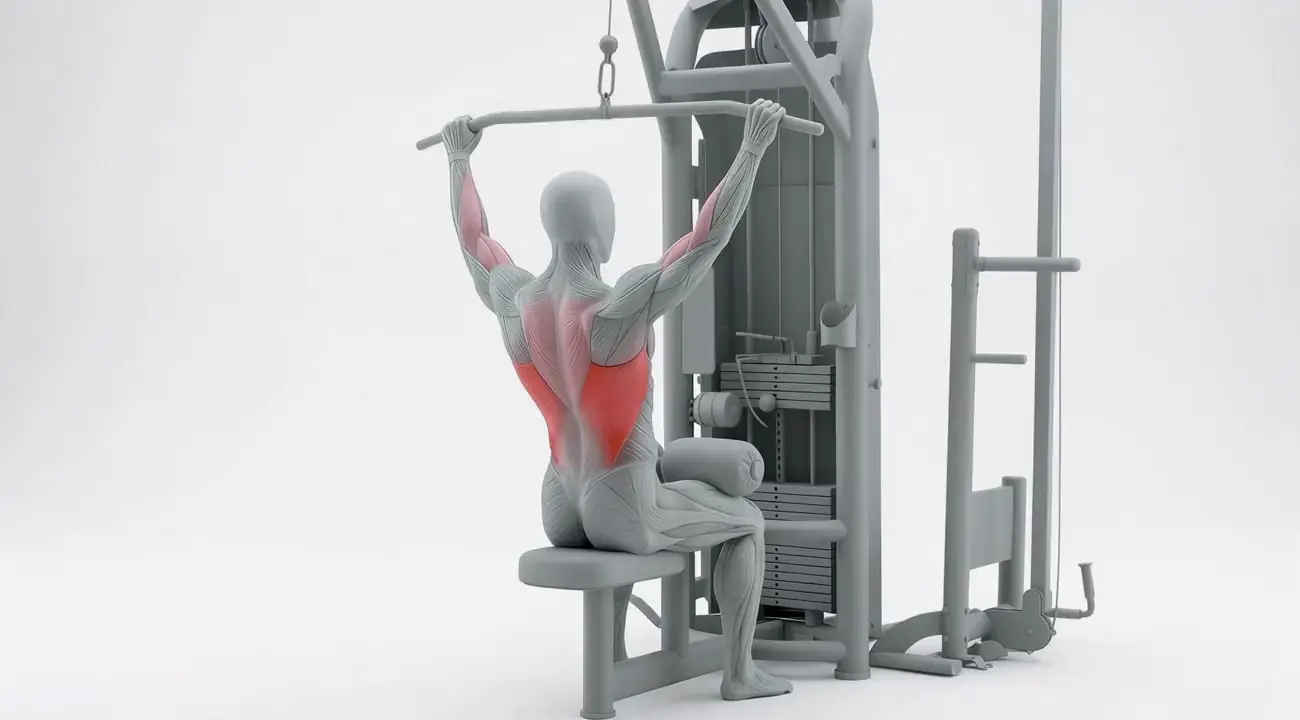
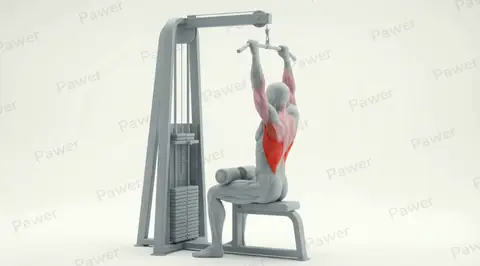
The lat pulldown is the seated cable analog of a pull-up. With the knees fixed under the pad and an overhand grip just outside shoulder width, you depress the shoulder blades, then flex the elbows and extend the shoulders until the bar reaches the upper chest. The latissimus dorsi and teres major drive it while the biceps, rhomboids, mid and lower traps and rear delts assist. EMG work across seven grip and trunk-angle variants found lat activation barely differed between them, so grip choice changes the assisting muscles more than the lats.
How to do the Lat Pulldown
- Attach a wide bar to the high pulley and set the thigh pad snug.
- Sit down and take the bar with palms forward, hands outside your shoulders.
- Sit tall with a slight backward lean and your arms fully extended.
- Pull your shoulder blades down before you bend your elbows.
- Draw the bar to your upper chest and pause with the lats contracted.
- Let the bar rise slowly to full arm extension and repeat.
Muscles worked
- Primary:
- Back


Why train it
- Trains the full vertical pull without needing bodyweight pull-up strength.
- Load adjusts in small steps, so progression is easy to program.
- The seated position keeps the torso stable and the lats loaded.
Common mistakes
- Leaning far back and turning the pulldown into a row, which shifts load off the lats.
- Shrugging the shoulders up at the start, so the traps take over before the lats engage.
- Letting the bar snap back to the top, which skips the loaded stretch.
- Pulling the bar behind the neck, which forces end-range shoulder rotation for no extra lat work.
Frequently asked questions
Is the lat pulldown as good as pull-ups?
For building your back, it is about as good. Both train the lats through the same vertical pull, and the pulldown lets you choose the weight, which makes it easier to stay in the 8 to 15 rep range where most growth happens. Pull-ups ask more of your core and grip and are the better test of relative strength, so the two fit well together.
Do lat pulldowns help you do pull-ups?
Yes, they build the same muscles, and they are one of the standard ways to work up to your first pull-up. They do not train the full-body tension of hanging from a bar, though. Pair pulldowns with dead hangs and slow lowering from the top of a pull-up bar to bridge the gap faster.
Should you pull the bar in front of or behind your head?
In front, to the upper chest. Pulling behind the neck forces the shoulders into a turned-out position and the head forward, which strains the shoulders and neck for no extra back work. Lean back slightly, about 10 to 20 degrees, and bring the bar to just below the collarbone.
Is wide grip or close grip better for lat pulldowns?
Neither is clearly better for growth. Studies comparing grips show similar lat activation. A grip a little wider than your shoulders is the usual default. A close neutral grip lets most people use more weight and get a longer stretch at the top. Pick the one that feels strongest in your back rather than your arms.
Why do I feel lat pulldowns in my biceps?
Because you are pulling with your hands instead of your elbows. Think of your hands as hooks, start each rep by pulling your shoulder blades down, and drive the elbows down towards your back pockets. A thumbless grip and lifting straps both help take the arms out of it.
What muscles does the Lat Pulldown work?
The Lat Pulldown trains the back as the main target. Expect the biceps, traps, shoulders, and core to take some of the load as well.
What equipment do I need for the Lat Pulldown?
The Lat Pulldown needs a cable machine. Nothing beyond that is required to run the movement the way it is described above.
Is the Lat Pulldown suitable for beginners?
Yes. The Lat Pulldown is rated beginner, and the machine holds the path for you, so there is little to get wrong once the seat and the pin are set.
Can I do the Lat Pulldown at home?
Only if your home setup runs to a cable machine. Most do not, so this is usually a gym movement. The alternatives below cover the same muscles with kit you are more likely to have.
How many sets and reps of the Lat Pulldown should I do?
Three to five sets of 6 to 12 reps. Pulling responds well to a full stretch at the top, so pick a load you can control all the way out rather than one you have to heave.
What are good alternatives to the Lat Pulldown?
Band Assisted Pull-Up, Chest-Supported Dumbbell Row, and Chest-Supported T-Bar Row train the same primary muscles as the Lat Pulldown. Pick whichever one suits the equipment in front of you.
Work out your Lat Pulldown weights
Estimate your max from a recent set, then find the weight for your next one.
- One Rep Max CalculatorTurn a recent set into an estimated max. Compare Epley, Brzycki and Lombardi, then read off your training percentages and every rep max from 2RM to 12RM.
- RPE CalculatorRate a set by effort, get an estimated max, and read off the weight for your next target. Includes a full RPE chart of percentages by reps and effort.
Similar exercises
By muscle
Every exercise is mapped to the muscles it trains. Browse by what you want to build.
By equipment
A full gym, a pair of dumbbells, or nothing at all: browse by what you have.