Workout split: how to pick the best one for your week
 Anton YefanovUpdated
12 min read
A workout split is how you divide your training across the week: which muscles you train on which day. The four that matter are full body, upper lower, push pull legs and the bro split. The best one is the one that fits the days you can actually train while hitting each muscle about twice a week. Below is a table that matches a split to every schedule from 2 to 6 days, and three complete plans with sets, reps and rest that you can start today. For more ready-made programs, see all workout routines.
- Days per week
- 2 to 6
- Plans included
- 3 full plans
- Level
- Beginner to advanced
- Equipment
- Full gym
Key takeaways
- A workout split decides which muscles you train on which day. Full body trains everything each session; the others divide the body into parts.
- Pick by days per week: 2 to 3 days full body, 4 days upper lower, 5 days upper lower plus push pull legs, 6 days push pull legs.
- In studies that match total sets, split and full body routines build the same muscle and strength. Weekly sets matter more than the split.
- Aim to train each muscle about twice a week with 10 or more hard sets per week. A split that trains a muscle once a week makes that harder.
- Start with the split you will not skip. Consistency over months beats the theoretically best plan you abandon in week three.
What is a workout split?
A workout split is the plan for how your training is divided across the week. Instead of doing whatever is free when you walk into the gym, each session has a job: legs on Tuesday, upper body on Thursday, or the whole body three times a week. The split sets which muscles you train together, how often each one gets worked, and how much rest it gets before the next session.
Three numbers follow from that choice. Frequency is how many times a week a muscle is trained. Volume is how many hard sets it gets in total. Session length is how much has to fit into one visit. A split is a trade between the three: more days let you spread the same sets over shorter sessions, fewer days pack them into longer ones.
| Split | How it divides the body | Days a week | Each muscle per week |
|---|---|---|---|
| Full body | Every major muscle, every session | 2 to 3 | 2 to 3 times |
| Upper lower | Upper body one day, legs the next | 4 | Twice |
| Push pull legs | Pressing, pulling, legs | 3 or 6 | Once or twice |
| Bro split | One or two muscle groups a day | 5 | Once |
The best workout split for 2 to 6 days a week
Start from your calendar, not from the split. Count the days you can train every week without fail, even in a busy month, and pick the split that turns that number into two sessions per muscle.
| Days a week | Best split | Each muscle per week | Session length |
|---|---|---|---|
| 2 | Full body (A and B) | Twice | 60 to 75 min |
| 3 | Full body (A, B, C) | 2 to 3 times | 50 to 60 min |
| 4 | Upper lower | Twice | 55 to 70 min |
| 5 | Upper lower + push pull legs | Twice | 50 to 65 min |
| 6 | Push pull legs | Twice | 60 to 75 min |
Every row lands on roughly the same place: each muscle trained about twice a week. That is not a coincidence. A meta-analysis of 25 studies found that frequency stops mattering once total sets are matched, but that in real programs, where more sessions usually mean more sets, higher frequencies came out modestly ahead (Schoenfeld et al., 2019). Twice a week is the practical way to fit enough sets in without three-hour sessions.
Full body split (2 to 3 days)
A full body split trains every major muscle in every session, with one or two exercises each. It is the best start for beginners and the most forgiving split for anyone with an unpredictable week: miss a day and nothing goes untrained, because the next session covers it.
Weekly schedule
Day A · Squat, bench, row
Hover or tap an exercise to see it
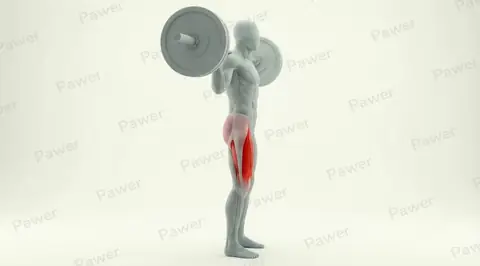 Barbell Squat
Quads
3 × 5-8
Rest 3 min
 Barbell Bench Press
Chest
3 × 6-8
Rest 2-3 min

3 × 8-10
Rest 2 min
 Dumbbell Lateral Raise
Shoulders
2 × 12-15
Rest 1 min
 Barbell Curl
Biceps
2 × 10-12
Rest 1 min
Stop each set with one to three good reps left. Only two days a week? Alternate A and B, and add the leg press to B.
Each day leads with a different big lift, so the squat, the Romanian deadlift and the leg press never land on the same day and the lower back gets a break between heavy sessions. Quads and back are trained all three days, chest and hamstrings twice.
The catch is the ceiling. With five exercises covering the whole body, there is little room for extra arm or shoulder work, and adding it makes sessions long. That is usually the sign to move to an upper lower split.
Upper lower split (4 days)
An upper lower split alternates an upper body day with a lower body day and runs the pair twice a week. Each muscle gets two sessions, and because each session only covers half the body, there is room for three or four exercises per area instead of one.
Weekly schedule
Upper · Chest, back, shoulders, arms
Hover or tap an exercise to see it
- Barbell Bench Press
Chest
3 × 6-8
Rest 2-3 min
3 × 6-8
Rest 2-3 min
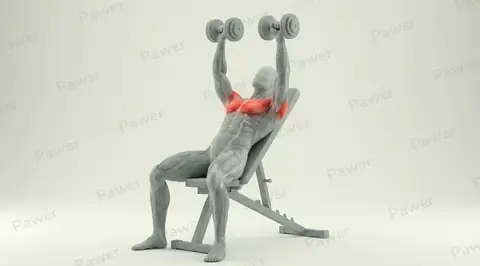
3 × 8-12
Rest 2 min
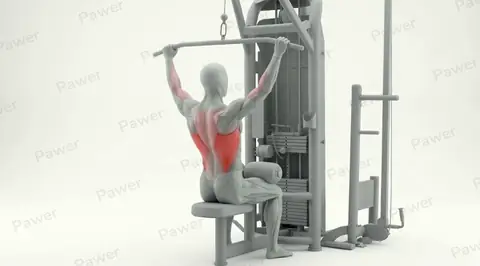 Lat Pulldown
Back · or pull-ups
3 × 8-12
Rest 2 min
- Dumbbell Lateral Raise
Shoulders
3 × 12-15
Rest 1 min
- Barbell Curl
Biceps
2 × 10-12
Rest 1 min
 Cable Rope Pushdown
Triceps
2 × 10-12
Rest 1 min
Run the same two sessions twice a week. To vary the second half of the week, swap the barbell bench for dumbbells and the squat for a hack squat or leg press.
Monday, Tuesday, Thursday, Friday is the classic layout: the midweek rest day splits the two pairs, and the weekend is free. Any four days work as long as the same session is never on back-to-back days twice in a row.
Upper lower is the split most lifters settle on after their first year. It gives every big lift two exposures a week, which is good for practicing the movement and adding weight, and it handles a missed session well: just do the next one in line.
5 day workout split: upper lower plus push pull legs
Five days is awkward for most splits. Push pull legs leaves one workout short, and a bro split trains each muscle only once. The cleanest fix is a hybrid: an upper and a lower day early in the week, then push, pull and legs after a rest day. Every muscle still gets two sessions, and the second half of the week uses lighter, higher-rep exercises so you arrive at Monday recovered.
Weekly schedule
Upper · Chest, back, shoulders, arms
Hover or tap an exercise to see it
- Barbell Bench Press
Chest
3 × 6-8
Rest 2-3 min
3 × 6-8
Rest 2-3 min
3 × 8-12
Rest 2 min
- Lat Pulldown
Back · or pull-ups
3 × 8-12
Rest 2 min
- Dumbbell Lateral Raise
Shoulders
3 × 12-15
Rest 1 min
- Barbell Curl
Biceps
2 × 10-12
Rest 1 min
- Cable Rope Pushdown
Triceps
2 × 10-12
Rest 1 min
Upper and lower are the same sessions as the 4 day plan. Push, pull and legs skip the heaviest barbell lifts so the week does not stack two heavy squat days.
If you would rather keep it simple, a rolling push pull legs cycle also works on five days: push, pull, legs, push, pull one week, then legs, push, pull, legs, push the next. It is easier to remember and harder to schedule around a fixed week.
Push pull legs and the bro split
Push pull legs groups the body by movement: pressing muscles one day, pulling muscles the next, legs on the third. Run three days a week it trains each muscle once; run six it trains each muscle twice with plenty of room for volume. It is the most popular split for intermediates building size, and it has its own page: the complete push pull legs routine with both schedules, sets, reps and progression.
The bro split gives each muscle group its own day: chest Monday, back Tuesday, shoulders Wednesday, arms Thursday, legs Friday. It is the classic bodybuilding layout, and the sessions are satisfying, but each muscle is trained only once a week. To reach the same weekly volume, you have to cram 15 or more sets for one muscle into a single session, and the last of them are done on tired muscles.
The research is mixed but leans away from it. In trained men, a split that hit each muscle once a week built less muscle in the arm flexors than a total body routine done three times a week, with no difference in strength (Schoenfeld et al., 2015). The bro split is not useless, but you get more from the same sets spread over two sessions.
Split vs full body: what the research says
The most direct answer comes from a 2024 meta-analysis that pooled 14 studies and 392 people comparing split routines with full body routines. When total training volume was the same, the two produced similar gains in bench press and leg strength, and similar growth in the arms, the thighs and lean body mass. Its authors concluded that people can choose a routine based on personal preference (Ramos-Campo et al., 2024).
Within split routines, how many times you train each week matters less than people think. Elite bodybuilders who trained four or six times a week for four weeks gained similar fat-free mass (4.2% vs 3.5%) and bench press strength (8.4% vs 11.4%), with no meaningful difference between the groups (Ribeiro et al., 2015).
What does matter is the total. A meta-analysis of 15 studies found a graded dose-response between weekly sets and muscle growth: each extra weekly set per muscle was linked to a little more growth, about 0.37% on average (Schoenfeld et al., 2017). So the useful question is not which split is best, but which split lets you do enough sets, recover from them, and keep showing up.
| Muscle | Full body (3 days) | Upper lower (4 days) | 5 day hybrid | PPL (6 days) |
|---|---|---|---|---|
| Chest | 6 | 12 | 11 | 12 |
| Back | 9 | 12 | 12 | 18 |
| Quads | 8 | 12 | 12 | 16 |
| Hamstrings | 5 | 12 | 9 | 12 |
| Side shoulders | 2 | 6 | 6 | 6 |
| Biceps | 2 | 4 | 5 | 10 |
| Triceps | 2 | 4 | 5 | 10 |
| Calves | 3 | 6 | 6 | 8 |
Read the table from left to right as a progression. The full body plan is deliberately lean: beginners grow on very little, and fewer sets leave more energy for learning the lifts. Each step right adds days and sets for lifters who have stopped progressing on less.
How to choose your workout split
- Count your reliable days. Not your best week, your normal one. That number picks the row in the table above.
- Check your experience. Under six months of lifting, run full body even if you have five days free. Spend the extra days walking, running or resting.
- Check your session length. If you have 45 minutes, choose more days with shorter sessions. If you can only come in twice, accept longer ones.
- Pick what you will enjoy. A split you look forward to gets done. That counts for more than any difference in the studies above.
- Run it for at least 8 to 12 weeks. Switching every month resets your progress on the lifts. Change splits when your schedule changes or progress has stalled for a month despite good sleep and food.
Best workout split for beginners
Full body, three days a week. You practice each big lift two or three times a week, which is how technique gets learned, and you recover easily between sessions. Most beginners can add weight to the main lifts almost every week for months on this plan.
Best workout split for muscle gain
Any split that trains each muscle twice a week with 10 or more hard sets: upper lower, the 5 day hybrid or six day push pull legs. Pick by the days you have. Once you can do that many sets and still recover, more days mostly buy you shorter sessions, not faster growth.
How to make any split work
Pick a weight you can lift for the bottom of each rep range and stop each set with one to three reps left, which is RPE 7 to 9 on the effort scale. Warm up with two or three lighter sets on the first lift of each session; the warm-up calculator gives the exact weights.
Then progress with double progression: keep the weight the same until you reach the top of the rep range on every set, then add the smallest jump (2.5 kg or 5 lb on upper body lifts, 5 kg or 10 lb on squats and deadlifts) and build the reps back up. The plate calculator loads the bar for you. This only works if you write every set down, because next week's target is last week's numbers plus one.
| Mistake | Fix |
|---|---|
| Choosing a 6 day split with a 3 day life | Pick the split for the days you never miss |
| Switching splits every few weeks | Run one for 8 to 12 weeks before judging it |
| Training one muscle once a week with huge sessions | Spread the same sets over two days |
| Adding exercises when progress stalls | Add a set, check sleep and food, then take a lighter week |
| Skipping the leg sessions | Move a missed session, do not drop it |
Frequently asked questions
What is the best workout split?
The one that fits the days you can train while working each muscle about twice a week: full body for 2 to 3 days, upper lower for 4, upper lower plus push pull legs for 5, and push pull legs for 6. With equal sets, studies find they build similar muscle.
What is the best workout split for beginners?
A three day full body split. It trains every muscle two or three times a week, lets you practice the main lifts often, and leaves plenty of time to recover.
Is a full body split better than a split routine?
Neither is better when weekly sets are the same. A 2024 meta-analysis of 14 studies found similar strength and muscle gains from both, so choose the one that fits your schedule.
How many days a week should I work out?
Three to four days is enough for most people to build muscle and strength. More days help mainly because they let you fit in more total sets without long sessions.
Is the bro split bad?
Not bad, but less efficient. Training each muscle once a week means very long single-muscle sessions to reach enough weekly volume, and one study in trained men found more arm growth when the same muscles were trained three times a week.
How long should I stick with a workout split?
At least 8 to 12 weeks. Change it when your available days change or when progress has stalled for a month despite good sleep, food and a lighter week.
Where does cardio go in a workout split?
On rest days or after lifting. Keep hard running or cycling away from the day before a lower body session so your legs are fresh for squats and deadlifts.
Studies and sources
Every study below was read for this article. Links go to PubMed or the publisher.
- Efficacy of Split Versus Full-Body Resistance Training on Strength and Muscle Growth: A Systematic Review With Meta-Analysis
Ramos-Campo DJ, Benito-Peinado PJ, Andreu-Caravaca L, Rojo-Tirado MA, Rubio-Arias JÁ. Journal of Strength and Conditioning Research, 2024;38(7):1330-1340
14 studies, 392 people: with volume equated, split and full body routines gave similar strength gains and muscle growth.
- How many times per week should a muscle be trained to maximize muscle hypertrophy? A systematic review and meta-analysis
Schoenfeld BJ, Grgic J, Krieger J. Journal of Sports Sciences, 2019;37(11):1286-1295
25 studies: with volume matched, frequency made no meaningful difference; without matching, higher frequencies came out modestly ahead.
- Dose-response relationship between weekly resistance training volume and increases in muscle mass
Schoenfeld BJ, Ogborn D, Krieger JW. Journal of Sports Sciences, 2017;35(11):1073-1082
15 studies: each additional weekly set was linked to about 0.37% more muscle gain, a graded dose-response.
- Influence of Resistance Training Frequency on Muscular Adaptations in Well-Trained Men
Schoenfeld BJ, Ratamess NA, Peterson MD, Contreras B, Tiryaki-Sonmez G. Journal of Strength and Conditioning Research, 2015;29(7):1821-1829
20 trained men: a total body routine three times a week grew the arm flexors more than a once-a-week split; strength gains were similar.
- Effect of Two- Versus Three-Way Split Resistance Training Routines on Body Composition and Muscular Strength in Bodybuilders: A Pilot Study
Ribeiro AS, Schoenfeld BJ, Silva DR, et al. International Journal of Sport Nutrition and Exercise Metabolism, 2015;25(6):559-565
10 elite bodybuilders, 4 weeks: training 4 or 6 times a week gave similar gains in fat-free mass (4.2% vs 3.5%) and bench press strength (8.4% vs 11.4%).