Upper lower split: the complete 4 day workout plan
 Anton YefanovUpdated
11 min read
An upper lower split alternates an upper body day (chest, back, shoulders, arms) with a lower body day (quads, hamstrings, glutes, calves) and usually runs four days a week, so every muscle gets two sessions. Below is a complete 4 day upper lower workout plan with a heavy and a lighter version of each day, every set, rep and rest time written out, the weekly sets it gives each muscle, 3 and 5 day versions, and how to add weight week after week. To compare it with other ways of dividing the week, see how to choose a workout split or browse all workout routines.
- Days per week
- 4 (or 3 or 5)
- Session length
- 55 to 70 min
- Level
- Beginner to intermediate
- Equipment
- Full gym
Key takeaways
- An upper lower split trains the upper body one day and the lower body the next, four days a week, so each muscle gets two sessions a week.
- This plan uses four different days: Upper A and Lower A are heavy (5 to 8 reps), Upper B and Lower B are for volume (8 to 15 reps).
- The classic schedule is Monday, Tuesday, Thursday, Friday. Three days works by rotating the four sessions; five days adds an arms and shoulders day.
- It gives 9 to 13 hard sets per week to every major muscle, in sessions of about an hour.
- With equal sets, upper lower and full body routines build similar strength and muscle. Upper lower wins on shorter, more focused sessions.
What is an upper lower split?
An upper lower split divides your training into two kinds of session. Upper days cover everything above the waist: chest, back, shoulders, biceps and triceps. Lower days cover the legs and hips: quads, hamstrings, glutes and calves, often with some core work. You alternate the two, and in the standard four day version you do each one twice a week.
That gives the split its main strength: every muscle is trained twice a week, which is the frequency most evidence-based coaches recommend, while each session only has to cover half the body. A full body session has room for one exercise per muscle. An upper or lower session has room for three or four, so you can train each muscle from more than one angle without spending two hours in the gym.
| Upper day | Lower day | |
|---|---|---|
| Muscles | Chest, back, shoulders, biceps, triceps | Quads, hamstrings, glutes, calves, abs |
| Main lifts | Bench press, row, overhead press, pull-ups | Squat, Romanian deadlift, hip thrust, leg press |
| Per week | Twice | Twice |
| Session length | 60 to 70 min | 55 to 65 min |
The 4 day upper lower split workout plan
Most upper lower plans repeat the same upper and the same lower session twice. This one uses four different days. The A days are heavy: the main barbell lifts for 5 to 8 reps with long rests, where strength is built. The B days are for volume: dumbbells, machines and cables for 8 to 20 reps with shorter rests, where most of the extra muscle-building sets live. You get practice on the big lifts and enough variety that no joint does the same thing four times a week.
Weekly schedule
Upper A · Heavy: bench, row, overhead press
Hover or tap an exercise to see it
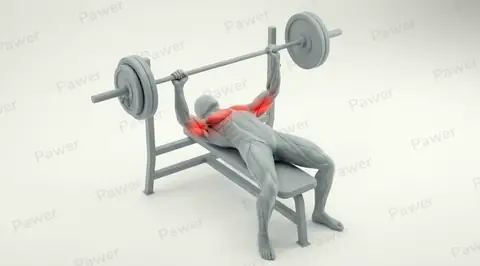 Barbell Bench Press
Chest
4 × 5-6
Rest 3 min

4 × 6-8
Rest 2-3 min
 Barbell Overhead Press
Shoulders
3 × 6-8
Rest 2-3 min
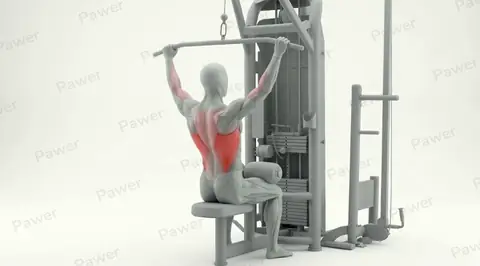 Lat Pulldown
Back
3 × 8-10
Rest 2 min
 Dumbbell Lateral Raise
Shoulders
3 × 12-15
Rest 1 min
 Barbell Curl
Biceps
2 × 8-10
Rest 1-2 min
 Cable Rope Pushdown
Triceps
2 × 10-12
Rest 1 min
Stop each set with one to three good reps left. On the 3 day schedule, keep rotating: next week starts with Lower B, then Upper A, then Lower A.
Lower A leads with the squat and Lower B with the hip thrust, so the heaviest squatting happens once a week and Lower B is easier on the lower back. Upper A opens with the bench press and the barbell row at low reps; Upper B moves to an incline, pull-ups and more arm work. Pull-ups on Upper B can be swapped for the lat pulldown until you can do six clean reps.
Weekly sets per muscle
| Muscle | A days | B days | Per week |
|---|---|---|---|
| Chest | 4 | 6 | 10 |
| Back (lats and upper back) | 7 | 6 | 13 |
| Front shoulders (overhead press) | 3 | 0 | 3 |
| Side shoulders | 3 | 3 | 6 |
| Rear shoulders | 0 | 2 | 2 |
| Biceps | 2 | 3 | 5 |
| Triceps | 2 | 3 | 5 |
| Quads | 6 | 7 | 13 |
| Hamstrings | 6 | 3 | 9 |
| Glutes (hip thrust) | 0 | 3 | 3 |
| Calves | 4 | 3 | 7 |
| Abs | 2 | 0 | 2 |
Every major muscle lands between 9 and 13 hard sets a week, which is a solid middle-of-the-road dose for lifters past their first few months. Arms and shoulders look low on paper but get plenty of indirect work from the compounds. If they lag, add one set to each arm exercise on the B days before adding anything else.
Upper lower split schedule: 3, 4 and 5 days
The four day layout is the one people mean by upper lower split, but the same sessions bend to other weeks. Pick the row that matches the days you can train without fail.
| Days | Mon | Tue | Wed | Thu | Fri | Sat | Sun |
|---|---|---|---|---|---|---|---|
| 4 (classic) | Upper A | Lower A | Rest | Upper B | Lower B | Rest | Rest |
| 4 (weekend) | Upper A | Rest | Lower A | Rest | Upper B | Lower B | Rest |
| 3 (rotating) | Next session | Rest | Next session | Rest | Next session | Rest | Rest |
| 5 | Upper A | Lower A | Rest | Upper B | Lower B | Arms and shoulders | Rest |
3 day upper lower split
With three days, keep cycling the four sessions in order: Upper A, Lower A, Upper B one week, then Lower B, Upper A, Lower A the next. Each muscle gets three sessions every two weeks instead of four. It is a good fit for beginners and for busy months, and you lose less than you might think: the same total sets per session still count.
5 day upper lower split
With five days, run the four day plan and add a short Saturday session for the muscles the split trains least: 3 sets each of lateral raises, face pulls, an incline curl, a hammer curl and a triceps extension. That lifts side shoulders, rear shoulders and arms toward 10 sets a week without making the main sessions longer. If you would rather train every muscle on all five days in rotation, the 5 day hybrid in the workout split guide pairs upper lower with push pull legs.
How to progress on an upper lower split
Use double progression. Pick a weight you can lift for the bottom of the rep range with one to three reps left in the tank, which is RPE 7 to 9 on the effort scale. Keep that weight until you hit the top of the range on every set, then add the smallest jump and build the reps back up.
| Lift type | Rep range | Add weight when | Jump |
|---|---|---|---|
| Heavy upper (bench, row, overhead press) | 5 to 8 | All sets at the top of the range | 2.5 kg / 5 lb |
| Heavy lower (squat, Romanian deadlift) | 5 to 8 | All sets at the top of the range | 5 kg / 10 lb |
| Dumbbell and machine work | 8 to 12 | All sets at the top of the range | Next dumbbell or plate |
| Isolation (raises, curls, calves) | 10 to 20 | All sets at the top of the range, clean reps | Smallest available |
Warm up with two or three lighter sets before the first lift of each day; the warm-up calculator gives the exact weights and the plate calculator loads the bar. If you want to start from a percentage of your max, the one rep max calculator estimates it from any recent set.
Rest matters more than it looks. In trained men doing the same total-body program, resting 3 minutes between sets instead of 1 minute led to bigger gains in squat and bench press strength and more growth in the thighs over 8 weeks (Schoenfeld et al., 2016). That is why the heavy lifts in this plan get 2 to 3 minutes. Do not cut rests short to save time; cut an isolation exercise instead.
Every five to eight weeks, or whenever two or more lifts stall for two weeks running, take a lighter week: same exercises, half the sets, a couple of reps further from failure. Then continue from your last good numbers.
Why heavy and light days?
Mixing a heavy and a lighter version of each day is called daily undulating periodization. It is not magic for muscle growth: a meta-analysis of 13 studies found that undulating and the more traditional linear periodization produced practically identical hypertrophy (effect size −0.02) (Grgic et al., 2017).
The reason to use it here is practical. Heavy sets of 5 build strength on the barbell lifts and are hard on joints and the nervous system; doing them four times a week wears most people down. Lighter sets of 10 to 15 on dumbbells and machines add muscle-building volume without that cost. Two heavy days and two lighter ones give you both, and the change of pace keeps the week from feeling like the same session four times.
Is an upper lower split good? What the research says
Yes, but not because it is a uniquely superior split. A 2024 meta-analysis of 14 studies and 392 people compared split routines with full body routines and found similar gains in bench press and leg strength, and similar growth in the arms, the thighs and lean body mass, as long as total volume was the same. The authors concluded that people can pick a routine on personal preference (Ramos-Campo et al., 2024).
Frequency follows the same pattern. A meta-analysis of 25 studies found no meaningful difference in muscle growth between training a muscle once or several times a week when weekly sets were matched; when they were not matched, higher frequencies came out modestly ahead, mainly because they made it easier to do more sets (Schoenfeld et al., 2019). Twice a week, which upper lower gives you by default, is the easy way to fit 10 or more sets per muscle into reasonable sessions.
One trial in 21 trained men compared a total body program with a split routine over 10 weeks. Both groups got stronger and bigger. The total body group improved more on an isokinetic bench press test, while the split group grew the outer thigh (vastus lateralis) more (Bartolomei et al., 2021). It is a small study, and the honest reading is the same as the meta-analysis: both work, and the differences are small.
| Split | Days | Each muscle per week | Best for |
|---|---|---|---|
| Full body | 2 to 3 | 2 to 3 times | Beginners, unpredictable weeks |
| Upper lower | 3 to 5 | Twice | Most lifters with four days |
| Push pull legs | 3 or 6 | Once or twice | Six days a week, building size |
| Bro split | 5 | Once | Lifters who like long single-muscle sessions |
Pros and cons
- Pro: two sessions per muscle with only four gym days, and a full rest day midweek.
- Pro: shorter, focused sessions. About an hour, with room for three or four exercises per area.
- Pro: forgiving. Miss a day and you simply do the next session in line.
- Con: lower days are hard. Squats, Romanian deadlifts and leg press in one session is a lot; that is why this plan splits the hardest leg work across two days.
- Con: upper days get long if you chase lots of arm and shoulder work. Use the fifth day for that instead.
Who should run an upper lower split?
Lifters with four days a week and at least a few months of training behind them. It is the most common next step after a beginner full body program, because it doubles the room for exercises without taking muscles below two sessions a week.
Beginners can run it too. Start with the 3 day schedule, cut every exercise to 2 or 3 sets, and spend the first month learning the lifts with weights that feel easy. If you have never trained before, a three day full body plan from the workout split guide is simpler to start with; switch to upper lower when sessions start to run long.
Women can run the plan as written. If glutes are the priority, add one set to the hip thrust and the Bulgarian split squat on Lower B and a set of hip thrusts at the end of Lower A. If you train at home with dumbbells, swap the barbell lifts for their dumbbell versions (goblet squat, dumbbell bench press, dumbbell Romanian deadlift) and keep the same sets and reps.
Common upper lower split mistakes
| Mistake | Fix |
|---|---|
| Doing the same heavy upper and lower day four times a week | Alternate heavy A days with lighter B days |
| Squats and deadlifts on the same day, twice a week | One heavy hinge or squat focus per lower day |
| Cutting rest to 60 seconds on the big lifts | Rest 2 to 3 minutes on compounds, cut an isolation exercise instead |
| Piling arm work onto upper days | Add a short fifth day or one set per arm exercise on B days |
| Skipping a lower day when tired | Move it, do not drop it: legs need both sessions |
| Not writing numbers down | Log every set, so next week's target is clear |
Frequently asked questions
Is an upper lower split good for building muscle?
Yes. It trains every muscle twice a week with 9 to 13 hard sets in this plan, which is enough for most lifters to keep growing. Studies find it builds similar muscle to full body training when weekly sets are equal.
How many days a week is an upper lower split?
Usually four: two upper days and two lower days. It also works on three days by rotating the sessions, or five by adding a short arms and shoulders day.
Is upper lower better than push pull legs?
Neither is better with the same weekly sets. Upper lower fits four days a week; push pull legs fits three or six. Pick the one that matches your schedule.
Can beginners do an upper lower split?
Yes. Run the 3 day rotating schedule with 2 to 3 sets per exercise and focus on learning the lifts. Complete beginners may find a full body plan simpler for the first few months.
Should I do upper or lower first in the week?
It does not matter. What matters is the order after that: alternate upper and lower, and never put two lower days back to back. Start with whichever day you least want to skip.
Where do abs and cardio go on an upper lower split?
Abs fit at the end of either day; this plan puts them on Lower A. Cardio goes on rest days or after upper sessions, away from the day before a lower session.
How long should I run an upper lower split?
At least 8 to 12 weeks, and as long as your lifts keep moving. Change exercises or take a lighter week when progress stalls, before changing the whole split.
Studies and sources
Every study below was read for this article. Links go to PubMed or the publisher.
- Efficacy of Split Versus Full-Body Resistance Training on Strength and Muscle Growth: A Systematic Review With Meta-Analysis
Ramos-Campo DJ, Benito-Peinado PJ, Andreu-Caravaca L, Rojo-Tirado MA, Rubio-Arias JÁ. Journal of Strength and Conditioning Research, 2024;38(7):1330-1340
14 studies, 392 people: with volume equated, split and full body routines gave similar strength gains and muscle growth.
- How many times per week should a muscle be trained to maximize muscle hypertrophy? A systematic review and meta-analysis
Schoenfeld BJ, Grgic J, Krieger J. Journal of Sports Sciences, 2019;37(11):1286-1295
25 studies: with volume matched, frequency made no meaningful difference; without matching, higher frequencies came out modestly ahead.
- A Comparison Between Total Body and Split Routine Resistance Training Programs in Trained Men
Bartolomei S, Nigro F, Malagoli Lanzoni I, Masina F, Di Michele R, Hoffman JR. Journal of Strength and Conditioning Research, 2021;35(6):1520-1526
21 trained men, 10 weeks: both groups improved; total body gained more isokinetic bench press strength, the split grew the vastus lateralis more.
- Effects of linear and daily undulating periodized resistance training programs on measures of muscle hypertrophy: a systematic review and meta-analysis
Grgic J, Mikulic P, Podnar H, Pedisic Z. PeerJ, 2017;5:e3695
13 studies: linear and daily undulating periodization gave similar muscle growth (d = −0.02).
- Longer Interset Rest Periods Enhance Muscle Strength and Hypertrophy in Resistance-Trained Men
Schoenfeld BJ, Pope ZK, Benik FM, et al. Journal of Strength and Conditioning Research, 2016;30(7):1805-1812
21 trained men, 8 weeks: 3 minute rests gave bigger squat and bench press gains and more thigh growth than 1 minute rests.