Workout split for women: a 3, 4 and 5 day gym plan
 Anton YefanovUpdated
11 min read
The best workout split for women is the same kind of split that works for anyone: one that trains every muscle about twice a week on the days you can actually show up. For most women that is a 4 day upper lower split that leads with the lower body, so glutes and legs get the most work. Below is that plan with every set, rep and rest time written out, the weekly sets it gives each muscle, 3 and 5 day versions, and what the research says about training as a woman, including your menstrual cycle. For the general guide to splits, see how to choose a workout split, or browse all workout routines.
- Days per week
- 4 (or 3 or 5)
- Session length
- 50 to 65 min
- Level
- Beginner to intermediate
- Equipment
- Full gym
Key takeaways
- Women do not need a different kind of split: in studies using the same program, women and men grow muscle at the same relative rate.
- The best fit for most women is a 4 day upper lower split with two lower days and two upper days, so every muscle gets two sessions a week.
- This plan leads with the lower body: hip thrusts, Romanian deadlifts, squats and lunges, with 9 or more direct glute sets a week and more from the compound lifts.
- Three days? Run lower, upper, lower. Five days? Add a glutes and shoulders day.
- You do not need to plan lifting around your cycle. Strength changes across it are trivial on average, so train by how you feel on the day.
What is the best workout split for women?
A workout split is how you divide your training across the week. The research-backed rule for choosing one is the same for women and men: train each muscle about twice a week, with enough hard sets, on a schedule you will keep. What changes from person to person is the number of days available and which muscles you most want to grow. Many women put glutes, legs and shoulders first, so the split below gives the lower body two full days and keeps upper body work focused on the back and shoulders.
| Days per week | Split | Each muscle per week | Best for |
|---|---|---|---|
| 2 | Full body x2 | Twice | Busy weeks, getting started |
| 3 | Lower, upper, lower | Lower twice, upper once | Beginners, glute priority |
| 4 | Upper lower (lower first) | Twice | Most women, the plan below |
| 5 | Upper lower plus a glute day | Two to three times | Intermediate, glute and shoulder focus |
If you are completely new to lifting, the 3 day version is the easiest to stick with. If you already lift and can train four days, start with the 4 day plan. Only move to five days once four feels easy to recover from; more days are not better if they cost you sleep or skipped sessions.
The 4 day workout split for women
Two lower days and two upper days. Lower A leads with the hip thrust and the Romanian deadlift for the glutes and hamstrings. Lower B leads with the squat, the leg press and lunges for the quads and glutes. Upper A is built around pulldowns, rows and presses for the back and shoulders; Upper B adds chest, rear shoulders and arms. Switch to the 3 or 5 day schedule with the tabs.
Weekly schedule
Lower A · Glutes and hamstrings
Hover or tap an exercise to see it
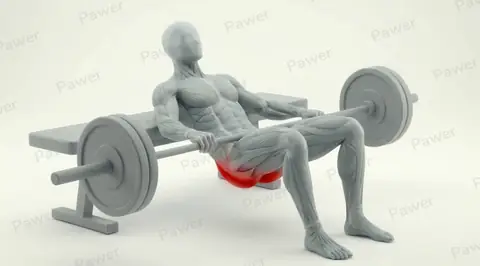 Barbell Hip Thrust
Glutes
4 × 6-10
Rest 2-3 min
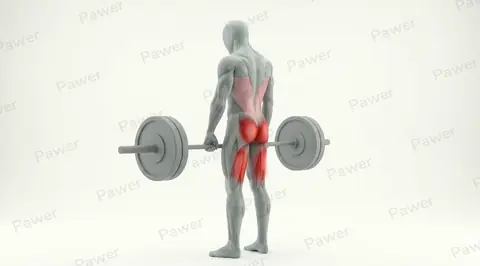 Barbell Romanian Deadlift
Hamstrings, Glutes
3 × 8-10
Rest 2-3 min
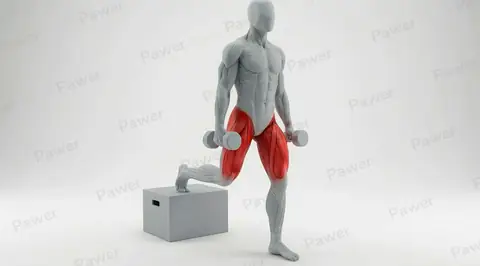 Dumbbell Bulgarian Split Squat
Glutes, Quads · per leg
3 × 8-12
Rest 1-2 min
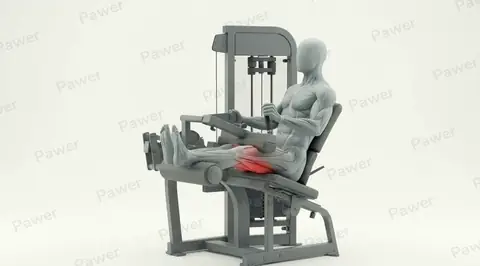 Seated Leg Curl
Hamstrings
3 × 10-12
Rest 1-2 min
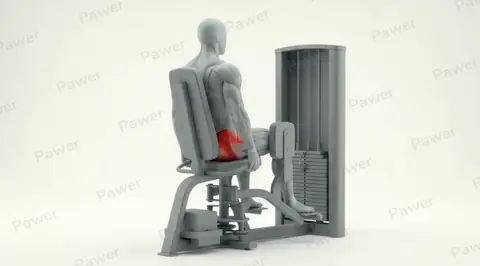 Machine Hip Abduction
Glutes
3 × 15-20
Rest 1 min
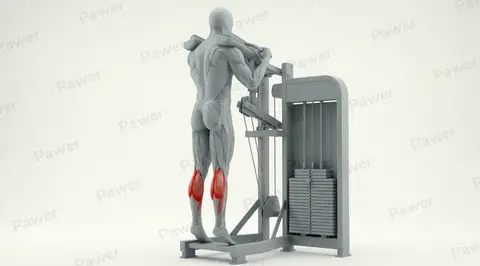
3 × 10-15
Rest 1 min
Stop each set with one to three good reps left. Glutes C is only for the 5 day schedule. On 3 days, swap Upper A for Upper B every other week.
No barbell squat rack, or not ready for one? Use the goblet squat for the same sets and reps and move to the barbell later. Pulldowns stand in for pull-ups so that every exercise can be loaded from the first session. The rep ranges are wide on purpose: the heavy lifts at the start of each day sit at 6 to 10 reps, isolation work at 10 to 20.
Weekly sets per muscle
| Muscle | 3 days | 4 days | 5 days |
|---|---|---|---|
| Glutes (thrusts, abduction, kickbacks, back extension) | 9 | 9 | 17 |
| Hamstrings | 9 | 9 | 12 |
| Quads | 13 | 13 | 13 |
| Back (lats and upper back) | 7 | 13 | 13 |
| Chest | 3 | 6 | 6 |
| Front shoulders | 3 | 3 | 3 |
| Side shoulders | 3 | 6 | 9 |
| Rear shoulders | 0 | 3 | 5 |
| Biceps | 2 | 4 | 4 |
| Triceps | 2 | 4 | 4 |
| Calves | 3 | 3 | 3 |
| Abs | 3 | 3 | 3 |
Glutes, hamstrings, quads and back all land around 9 to 13 hard sets a week on the 4 day plan, a solid dose for anyone past their first few months. Chest and arms are lower by design. If you want more, add one set to the chest press and to each arm exercise on Upper B before adding anything else.
3, 4 and 5 day workout split for women: the schedule
| Days | Mon | Tue | Wed | Thu | Fri | Sat | Sun |
|---|---|---|---|---|---|---|---|
| 3 | Lower A | Rest | Upper A or B | Rest | Lower B | Rest | Rest |
| 4 | Lower A | Upper A | Rest | Lower B | Upper B | Rest | Rest |
| 5 | Lower A | Upper A | Rest | Lower B | Upper B | Glutes C | Rest |
3 days: lower, upper, lower trains the legs and glutes twice a week and the upper body once. Alternate Upper A and Upper B so every upper exercise comes round every two weeks. For a full body option on three days instead, see the 3 day workout split.
4 days: the standard plan. The rest day on Wednesday keeps the two lower sessions three days apart, so your legs are fresh for Lower B. The weekend is free. For the classic upper lower layout with heavier barbell days, see the upper lower split.
5 days: Glutes C adds a third glute session and extra side and rear shoulder work. It is shorter than the other days, about 40 minutes. Keep it on Saturday, two days after Lower B and two days before Lower A. Other ways to spread five days are in the 5 day workout split.
Do women need a different workout split than men?
No. A 2020 meta-analysis pooled studies in which men and women ran the same resistance training program. For muscle growth (10 studies), there was no significant difference between the sexes. For lower body strength (23 studies) there was no significant difference either, and for relative upper body strength (17 studies) women actually improved more (Roberts et al., 2020). Women start with less muscle and lower absolute strength, but they respond to training at the same rate or faster.
There is one real difference worth knowing. Women are usually less fatigable than men in sustained or repeated contractions at the same relative effort, although the gap depends on the task, the muscle and the speed of contraction (Hunter, 2014). It does not change the split. It is one more reason the 1 minute rests on raises, curls and abduction suit most women well, and a reminder that a set of 12 at a weight you could lift for 15 is not a hard set. Use the RPE scale to judge effort rather than a fixed weight.
What usually differs is the goal. Women more often want stronger glutes and legs and defined shoulders than a bigger chest, which is why this plan gives the lower body two full days and the chest only a few sets. If your goals look different, the same sessions work with the emphasis moved; the 4 day workout split guide shows other layouts.
Should you plan your split around your menstrual cycle?
Cycle syncing is popular, but the evidence does not support rearranging your training around it. A 2020 meta-analysis of 78 studies in women with regular cycles found that performance might be trivially lower in the early follicular phase (the days around your period) than in the rest of the cycle. The effect was so small, the studies so varied and the evidence quality so low that the authors said no general guideline could be made, and recommended a personal approach instead (McNulty et al., 2020).
The muscle-building response looks the same across the cycle too. In a controlled study, 12 young women trained one leg in their late follicular phase and the other in their mid-luteal phase. Muscle protein synthesis rose with exercise to almost the same rate in both phases (1.52 and 1.46 percent per day), with no effect of cycle phase on synthesis or breakdown (Colenso-Semple et al., 2025).
Hip thrusts or squats for glutes?
Both, which is why this plan has a hip thrust day and a squat day. In a 9 week trial with untrained young adults, one group trained only the back squat and the other only the hip thrust, with the same number of sets. Glute growth was similar in both groups. The squat group grew more in the quads and adductors, and each group got stronger mainly in its own lift (Plotkin et al., 2023). The hip thrust also lit up the glutes more on EMG in the first session, but that did not predict who grew more.
So the hip thrust is not magic and the squat is not only a leg exercise. Use the thrust to load the glutes heavily without taxing the lower back, the squat and lunges to grow the quads and glutes together, and hip abduction and kickbacks to add volume for the upper glutes at the end of the session.
| Exercise | Day | What it adds |
|---|---|---|
| Hip thrust | Lower A, Glutes C | Heavy glute loading, low back stress |
| Romanian deadlift | Lower A | Glutes and hamstrings at long length |
| Bulgarian split squat | Lower A | One leg at a time, deep hip bend |
| Squat | Lower B | Quads and glutes together |
| Hip abduction | Lower A, Glutes C | Upper glutes, easy to recover from |
| Cable kickback | Lower B | Glute isolation without loading the spine |
How to progress
Use double progression. Pick a weight you can lift for the bottom of the rep range with one to three reps left. Keep it until you reach the top of the range on every set, then add the smallest jump and build the reps back up. Write every set down, so you know what to beat next time.
| Lift type | Rep range | Add weight when | Jump |
|---|---|---|---|
| Hip thrust, squat, Romanian deadlift | 6 to 10 | All sets at the top of the range | 5 kg / 10 lb |
| Pulldown, rows, presses | 8 to 12 | All sets at the top of the range | Next plate or dumbbell |
| Lunges and split squats | 8 to 12 per leg | All sets at the top of the range | Next dumbbell |
| Raises, curls, abduction, kickbacks | 12 to 20 | All sets at the top, clean reps | Smallest available |
Before the first lift of each day, do two or three lighter sets; the warm-up calculator gives the weights and the plate calculator loads the bar. Every six to eight weeks, or when two lifts stall for two weeks running, take a lighter week with half the sets, then carry on from your last good numbers.
Frequency matters less than total sets. A meta-analysis of 25 studies found that, with the same weekly sets, training a muscle once or several times a week built similar muscle, and higher frequencies only came out modestly ahead when they added sets (Schoenfeld et al., 2019). Twice a week is simply the easiest way to fit 10 or more sets per muscle into sessions of under an hour, which is what this split is built to do.
Adjusting the split to your goal
| Goal | Schedule | Change |
|---|---|---|
| Grow glutes | 4 or 5 days | Run as written; add Glutes C when four days feel easy |
| Lose fat | 3 or 4 days | Keep the lifting, add 2 to 3 walks or easy cardio sessions on other days |
| Get stronger | 4 days | Keep the first lift of each day at 5 to 8 reps and rest 3 minutes |
| Busy schedule | 3 days | Lower, upper, lower; cut the last exercise if short on time |
| Train at home | 3 or 4 days | Use the dumbbell workout plan swaps |
For fat loss, lifting is what tells your body to keep its muscle while you eat less, so keep the sets and the weights and let the diet and walking do the rest. Put cardio on rest days or after upper sessions, not right before a lower day.
Common mistakes
| Mistake | Fix |
|---|---|
| Lifting light weights for very high reps to tone | Toning is muscle plus lower body fat; use weights that make 8 to 15 reps hard |
| Training glutes every day | Two or three glute sessions a week with rest between |
| Skipping upper body days | Back and shoulders shape the whole silhouette; keep both upper days |
| Changing exercises every week | Keep them for 8 to 12 weeks so you can add weight |
| Stopping every set far from failure | Finish with one to three reps left in the tank |
| Not writing numbers down | Log every set so next week's target is clear |
Frequently asked questions
What is the best workout split for women?
For most women, a 4 day upper lower split that puts the lower body first. It trains every muscle twice a week and gives glutes and legs two full days. With three days, run lower, upper, lower.
Should women train differently from men?
Not in any basic way. In studies using the same program, women gained muscle at the same relative rate as men and gained upper body strength faster. Goals differ more than biology does.
Is a 3 day workout split enough for women?
Yes. Lower, upper, lower trains the legs and glutes twice a week and the upper body once, which is plenty to build muscle and strength, especially in your first year.
How many days a week should a woman lift weights?
Three to four days suits most women. Five works for intermediate lifters who recover well. Two full body days is still worthwhile when life is busy.
Should I change my workouts during my period?
You do not need to. Research finds at most a trivial dip in performance around your period. Keep the plan and drop a set or two on days you feel rough.
Will lifting heavy make women bulky?
No. Building noticeable muscle takes years of hard training and eating enough. Lifting heavy builds the firm, shaped look most women mean by toned.
How long should I follow this workout split?
At least 8 to 12 weeks, and as long as your lifts keep improving. Change a few exercises or take a lighter week when progress stalls before changing the whole split.
Studies and sources
Every study below was read for this article. Links go to PubMed or the publisher.
- Sex Differences in Resistance Training: A Systematic Review and Meta-Analysis
Roberts BM, Nuckols G, Krieger JW. Journal of Strength and Conditioning Research, 2020;34(5):1448-1460
Same program for both sexes: no difference in hypertrophy (10 studies) or lower body strength (23 studies); women gained more relative upper body strength (17 studies).
- Sex differences in human fatigability: mechanisms and insight to physiological responses
Hunter SK. Acta Physiologica, 2014;210(4):768-789
Review: women are usually less fatigable than men at similar intensities, depending on the task, muscle and contraction type.
- The Effects of Menstrual Cycle Phase on Exercise Performance in Eumenorrheic Women: A Systematic Review and Meta-Analysis
McNulty KL, Elliott-Sale KJ, Dolan E, et al. Sports Medicine, 2020;50(10):1813-1827
78 studies: performance might be trivially reduced in the early follicular phase; no general guidelines possible, a personal approach is recommended.
- Menstrual cycle phase does not influence muscle protein synthesis or whole-body myofibrillar proteolysis in response to resistance exercise
Colenso-Semple LM, McKendry J, Lim C, et al. Journal of Physiology, 2025;603(5):1109-1121
12 young women: exercise raised muscle protein synthesis similarly in the late follicular and mid-luteal phases; no effect of phase.
- Hip thrust and back squat training elicit similar gluteus muscle hypertrophy and transfer similarly to the deadlift
Plotkin DL, Rodas MA, Vigotsky AD, et al. Frontiers in Physiology, 2023;14:1279170
34 untrained adults, 9 weeks, sets equated: similar glute growth; squats grew the quads and adductors more.
- How many times per week should a muscle be trained to maximize muscle hypertrophy? A systematic review and meta-analysis
Schoenfeld BJ, Grgic J, Krieger J. Journal of Sports Sciences, 2019;37(11):1286-1295
25 studies: with volume matched, frequency made no meaningful difference; without matching, higher frequencies came out modestly ahead.