Tempo Run
 Anton YefanovUpdated
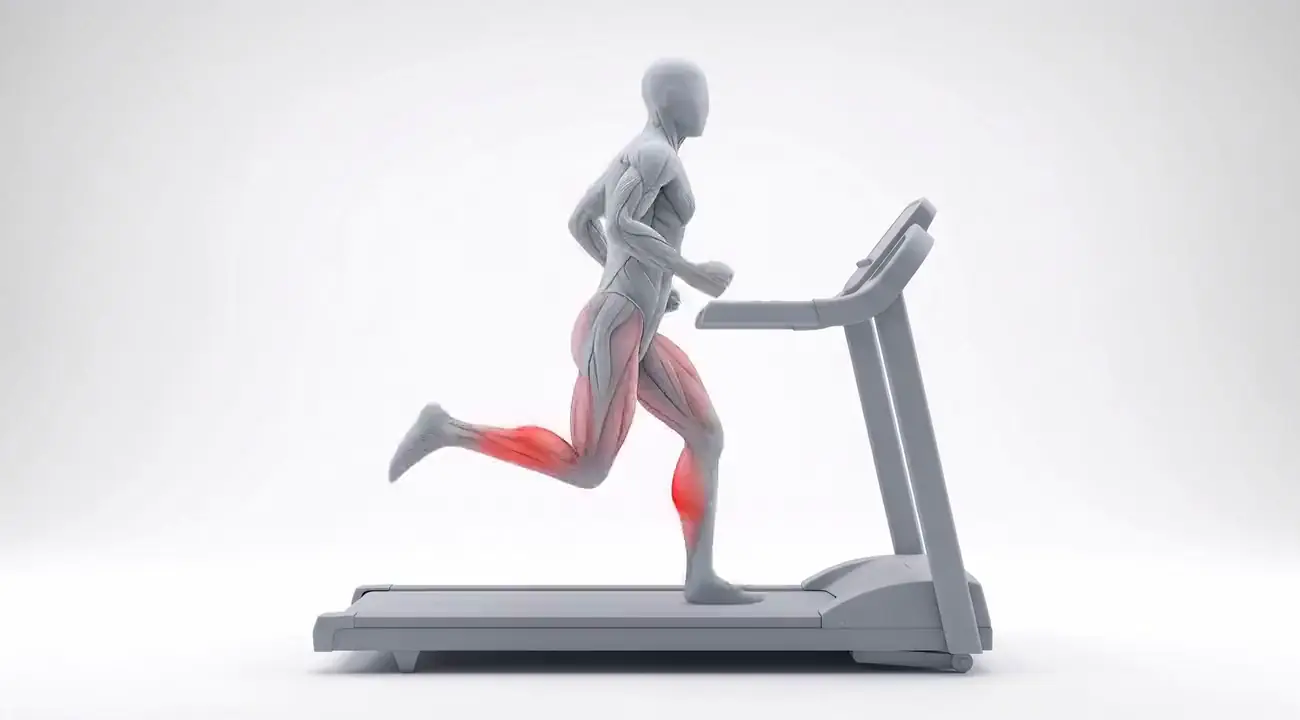
A tempo run sits at the pace where lactate production and clearance balance. The lactate threshold is the fastest steady state a runner can hold without fatiguing, and continuous threshold work is normally built from about ten minutes toward thirty. Reviews of distance running training put that zone at roughly two to four and a half millimoles per liter of blood lactate.
The mechanics are ordinary running held at an unusually disciplined effort. The vastus group, gluteal muscles and plantar flexors do the same work they do at every pace, and the adaptation targeted is improved lactate clearance rather than top-end speed.
How to do the Tempo Run
- Warm up with easy running for several minutes until breathing has lifted.
- Lift the pace gradually into an effort you could hold for around twenty to thirty minutes.
- Settle into a rhythm where speech is limited to short phrases rather than sentences.
- Run tall with the hips forward and a relaxed upper body, keeping cadence even.
- Hold that single effort for the full block instead of surging and backing off.
- Ease down into an easy jog once the tempo block is finished.
Muscles worked
- Secondary:
- Hamstrings and Core


Why train it
- Improves the ability to clear lactate, which raises the pace that can be sustained.
- Delivers a large aerobic stimulus without the recovery cost of maximal interval work.
- Recruits faster motor units at a moderate metabolic intensity, avoiding excessive fatigue.
Common mistakes
- Running the tempo at interval pace, which turns a sustainable effort into a session you cannot finish.
- Surging and easing repeatedly, which breaks the steady lactate balance that makes the session work.
- Extending the block too quickly week to week, which outpaces the gradual progression the adaptation depends on.
- Skipping the warm-up, so the first minutes are spent finding the pace rather than holding it.
Frequently asked questions
What muscles does the Tempo Run work?
The Tempo Run works the quads, glutes, and calves hardest, with the hamstrings and core pitching in. As cardio, though, the bigger demand is on your heart and lungs rather than any one muscle.
What equipment do I need for the Tempo Run?
The Tempo Run needs a treadmill. Nothing beyond that is required to run the movement the way it is described above.
Is the Tempo Run suitable for beginners?
With some base fitness. The Tempo Run is rated intermediate: it assumes you can already hold 20 minutes or so of steady effort. Build that first with easier steady sessions, and the alternatives below are the easier way in.
Can I do the Tempo Run at home?
Yes, if you own a treadmill. That is the whole requirement, and it is the reason this one travels well between a home setup and a gym floor.
How long should I do the Tempo Run for?
20 to 40 minutes at threshold after a 10 minute warm-up, or the same time split into two or three blocks with a short easy jog between them. Once a week is enough.
What are good alternatives to the Tempo Run?
Running Intervals, Treadmill Run, and Steady State Ride train the same primary muscles as the Tempo Run. Pick whichever one suits the equipment in front of you.
Work out your Tempo Run weights
Estimate your max from a recent set, then find the weight for your next one.
- One Rep Max CalculatorTurn a recent set into an estimated max. Compare Epley, Brzycki and Lombardi, then read off your training percentages and every rep max from 2RM to 12RM.
- RPE CalculatorRate a set by effort, get an estimated max, and read off the weight for your next target. Includes a full RPE chart of percentages by reps and effort.
Similar exercises



By muscle
Every exercise is mapped to the muscles it trains. Browse by what you want to build.
By equipment
A full gym, a pair of dumbbells, or nothing at all: browse by what you have.