Front Squat
 Anton YefanovUpdated
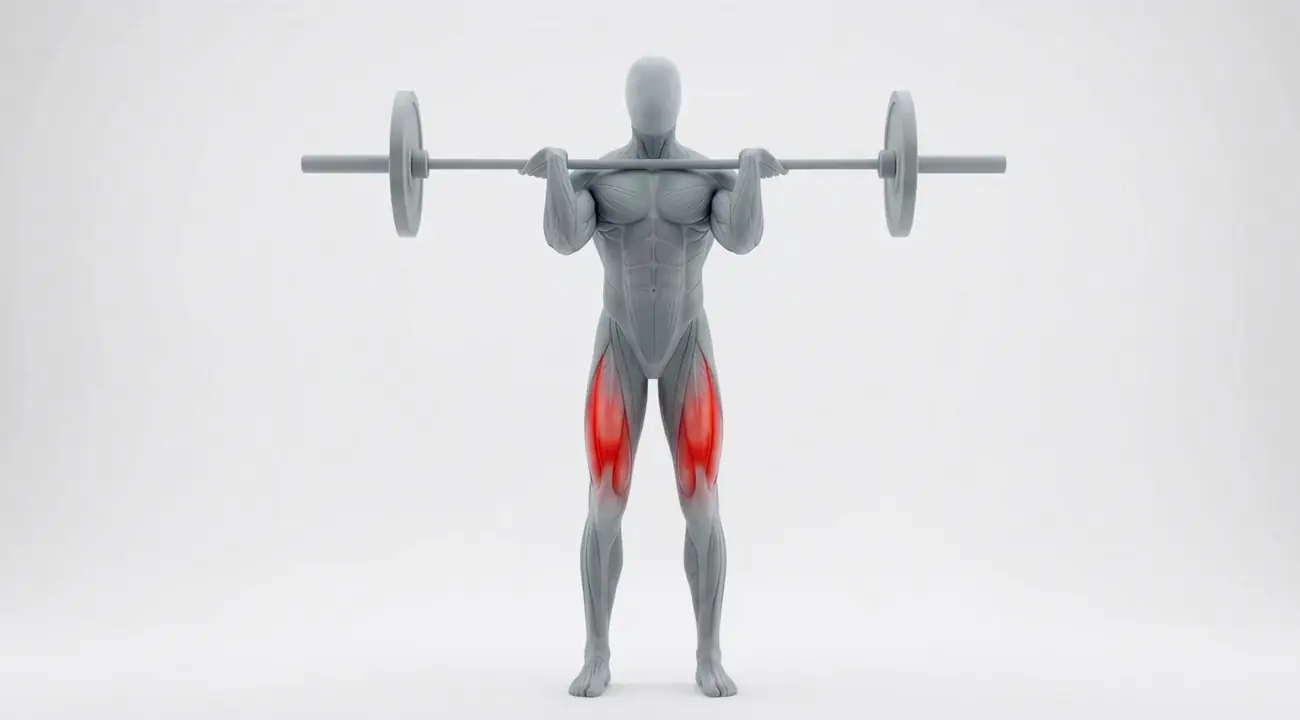
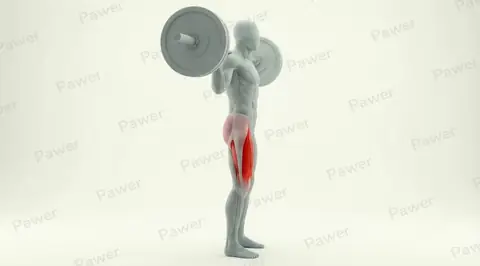
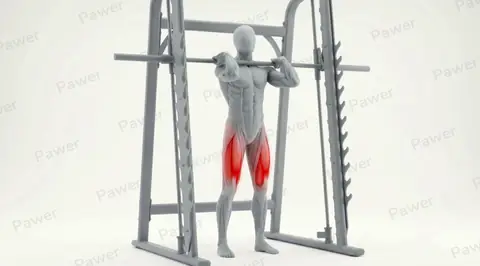
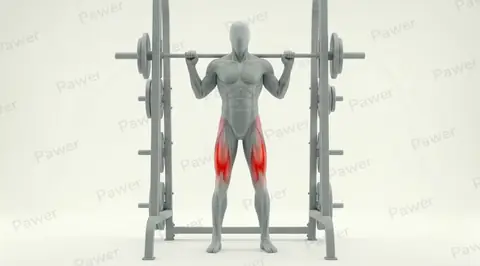
The front squat carries the bar across the front of the shoulders with the elbows driven high, so the torso must stay upright through the whole repetition. That position keeps the load close to the knees and makes the quadriceps the prime mover, while the glutes extend the hips and the trunk and upper back work to stop the chest folding forward. The upright posture is exactly why the quads take a larger share than in a back squat, and wrist and thoracic mobility usually limit the lift before leg strength does.
How to do the Front Squat
- Set the bar at upper chest height and step under it in the rack.
- Rest the bar across your front delts and drive your elbows high.
- Stand the bar out and set your feet just inside shoulder width.
- Brace your trunk and descend by bending the knees and hips together.
- Lower until your thighs are at least parallel, keeping the chest tall.
- Push through the whole foot and drive the elbows up to stand.
Muscles worked
- Primary:
- Quads
- Secondary:
- Glutes, Core, Traps, Hamstrings, and Adductors
Why train it
- The front rack forces an upright torso, so the quadriceps take the largest share.
- Failed reps can be dumped forward, which makes heavy work safer without a spotter.
- It builds the trunk and upper back bracing that carries into cleans and back squats.
Common mistakes
- Letting the elbows drop, which rolls the bar forward and dumps you out of the rack.
- Rising onto the toes, which shifts the bar ahead of the midfoot and stalls the lift.
- Rounding the upper back out of the bottom, which loads the spine instead of the legs.
- Letting the knees travel far inside the toes, which strains the joint and cuts quad force.
Frequently asked questions
Are front squats better than back squats?
Neither is better overall. The front squat keeps your torso more upright, works the quads a little harder and puts less load on the lower back. The back squat lets you lift about 20 to 25 percent more and trains the hips and back more. Pick the one that matches your goal, or run both in the same week.
How do you hold the bar on a front squat?
Rest the bar on the front of your shoulders, against your throat, with your elbows pointing forward and up. Your fingers only steady the bar, they do not hold it. If your wrists cannot bend that far, use only two or three fingers, or cross your arms over the bar. Straps looped around the bar also work.
Why do my wrists hurt on front squats?
Usually because the bar is resting in your hands instead of on your shoulders. Push your elbows higher so the bar sits back on the shoulders, and loosen your grip to a few fingers. Tight forearms, lats and triceps all limit the rack position, so stretching them before you squat helps too.
Do front squats help your back squat?
Yes. They build the quads and upper back strength that keep your chest up out of the bottom of a back squat, which is where many lifters fail. Plenty of strength programs use front squats as a second squat day for exactly that reason.
Are front squats easier on your back?
Generally yes. The bar in front keeps your torso upright, which reduces the bending load on the lower back. You also cannot lift as much, so the total load on the spine is lower. Many people with back trouble find front squats more comfortable than back squats.
What muscles does the Front Squat work?
The Front Squat trains the quads as the main target. Expect the glutes, core, traps, hamstrings, and adductors to take some of the load as well.
What equipment do I need for the Front Squat?
The Front Squat needs a barbell. Nothing beyond that is required to run the movement the way it is described above.
Is the Front Squat suitable for beginners?
With some training behind you. The Front Squat is rated intermediate, which means the setup matters as much as the effort. It is a reasonable first month goal rather than a first session one, and the alternatives below are the easier way in.
Can I do the Front Squat at home?
Yes, if you own a barbell. That is the whole requirement, and it is the reason this one travels well between a home setup and a gym floor.
How many sets and reps of the Front Squat should I do?
Three to five sets of 5 to 10 reps. Rest two to three minutes: squats tire the whole body, and a rushed second set is where depth and bracing fall apart.
What are good alternatives to the Front Squat?
Cossack Squat, Dumbbell Bulgarian Split Squat, and Sissy Squat train the same primary muscles as the Front Squat. Pick whichever one suits the equipment in front of you.
Work out your Front Squat weights
Estimate your max from a recent set, then find the weight for your next one.
- One Rep Max CalculatorTurn a recent set into an estimated max. Compare Epley, Brzycki and Lombardi, then read off your training percentages and every rep max from 2RM to 12RM.
- RPE CalculatorRate a set by effort, get an estimated max, and read off the weight for your next target. Includes a full RPE chart of percentages by reps and effort.
- Barbell Plate CalculatorSee which plates go on each side of the bar for any weight, using only what your gym stocks. Count a loaded bar, add collars, and switch bars.
- Warm-Up CalculatorGet every warm-up set for your working weight, with reps, rest and the plates per side. Ramps for work sets, heavy singles, meets and 5x5 programs.
Similar exercises
By muscle
Every exercise is mapped to the muscles it trains. Browse by what you want to build.
By equipment
A full gym, a pair of dumbbells, or nothing at all: browse by what you have.